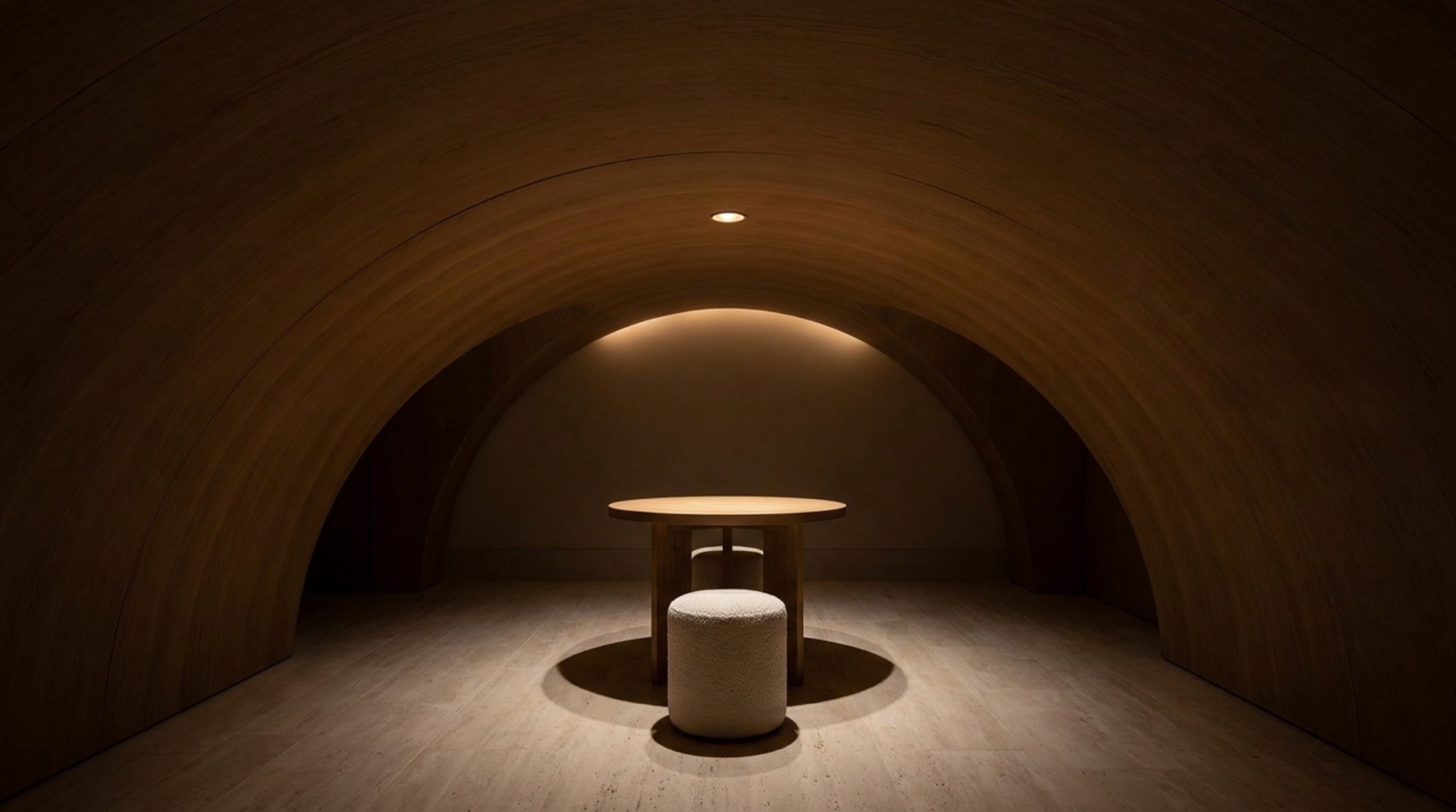
There is a reason you instinctively choose the corner banquette in the restaurant, facing the door. The reason is older than language, older than architecture, older than the human family. It is the same reason a child builds the blanket fort with one opening, the reason the desk you concentrate at sits with its back to the wall, the reason you have never relaxed inside a sealed glass box no matter how beautiful the view. Your nervous system is reading the room the way your ancestors read the savanna, and it is still looking for the same thing.
It is looking for the cave with a view of the grass.
In 1975, a British geographer-poet named Jay Appleton published _The Experience of Landscape_, a book whose central thesis was at once heretical and obvious. Aesthetic preference, he argued, was not aesthetic at all. It was survival logic, expressed as taste. We prefer the landscapes we prefer because, in the long arc of human evolution, those landscapes were the ones that kept us alive. He gave the underlying reflex a name borrowed from the ethologist Konrad Lorenz: _to see without being seen_. Then he gave the geometry of it a name of his own. He called it prospect and refuge.
Prospect
Prospect is the visible field. It is the open ground in front of the cave mouth, the savanna seen from a tree limb, the dining room seen from the kitchen counter. Prospect is what you can survey without moving. The longer the sightline, the deeper the field; the more carefully framed, the more legible the threats and opportunities inside it. Appleton (1975) divided prospect into _direct_ and _indirect_, and direct prospect again into panorama and vista. The panorama is the 360-degree view; the vista is the framed one, simple, horizontal, or peephole. Most modern luxury homes confuse panoramic prospect for the highest expression of architectural reach. The body disagrees. The 360-degree view triggers vigilance, not relaxation, because there is nowhere to put your back. The vista, the framed view from a settled position, is the geometry the nervous system actually settles into.
Refuge
Refuge is the place behind you. Appleton (1975) categorised refuge by function (hides versus shelters versus composite), by origin (natural, artificial, composite) and by substance (earth, vegetation, nebulous: caves, hedges, mist). The corner banquette in the restaurant is refuge. The window seat in the bay is refuge. The deep eaves of a cottage are refuge. The wing-back chair turned toward the fire, with the door visible in the room beyond, is refuge. What every refuge condition shares is that the body is enclosed on at least two sides, the head is sheltered above, and the eye still has prospect. The cave is not the destination. The cave with the view is the destination.
Hazard
Appleton's third category is the one most modern designers have forgotten. _Hazard_ is the threat that prospect-refuge is calibrated against. He divided hazards into three types: incident hazards (a fire, a predator, an unstable surface), impediment hazards (a cliff, a dense thicket, a hedge that blocks escape), and deficiency hazards (hunger, thirst, exposure). Without a hazard to be safe from, prospect-refuge collapses into a meaningless compositional formula. The reason a great room in a great house feels great is that the hazard is implicit. The fireplace is fire, contained and tended. The terrace is a cliff, made survivable. The deep window-well is the open ground at the cave mouth, made framed and crossable. The architecture is, in every case, a negotiation with a danger that is no longer literally present, but that the nervous system still remembers.
The biological substrate
Prospect-refuge is sometimes dismissed as evocative metaphor. The biology is not metaphorical. The reflex is mediated through the autonomic nervous system, specifically the sympathetic-parasympathetic balance that governs vigilance and rest. A space that fails to resolve prospect-refuge keeps the sympathetic system engaged at a low level: cortisol elevated by perhaps fifteen or twenty percent above baseline, heart-rate variability suppressed, sleep latency lengthened, working-memory load slightly higher. None of this is acute enough to register as discomfort. It registers as a low hum the body cannot quite locate. People say _the room feels off_, and they leave.
The cumulative cost is measurable. Sympathetic dominance maintained over years contributes to allostatic load, the wear-and-tear index that biologists track as a precursor to most age-accelerated disease (McEwen 1998). Spaces that resolve the prospect-refuge instinct cleanly are not merely pleasant. They are nervous-system permission slips. They tell the body, this is the cave with the view; you can settle.
Hildebrand's pattern
The decisive translation of Appleton's landscape thesis into architecture was made in 1991 by Grant Hildebrand, in _The Wright Space_, and expanded in his 1999 _Origins of Architectural Pleasure_. Hildebrand analysed thirty-three of Frank Lloyd Wright's domestic houses and identified a repetitive spatial formula, which he called Wright's pattern. He counted thirteen separate elements; the pattern is densest in the Arthur Heurtley House, completed 1902. The most consequential five are these.
First: the major spaces sit elevated above the terrain they overlook. The body is on the high ground.
Second: the fireplace is withdrawn to the heart of the house, beneath a low ceiling, with built-in seating drawing the body into the recess. This is the refuge.
Third: the ceiling forward of the fireplace zone sweeps upward, releasing the eye into the long room. This is the transition from refuge to prospect.
Fourth: the glazing is placed on walls distant from the fire, framing the view as a horizontal band rather than a curtain wall. The vista is composed.
Fifth: a generous, elevated terrace sits beyond the glazing, mediating between interior shelter and exterior open ground, with deep overhanging eaves above. The cliff is made survivable.
Hildebrand observed that Wright himself was not consciously articulate about the pattern, and that most architectural critics had missed it. What Wright knew without saying was that the pattern reads as deeply right because it reproduces, indoors, the spatial sequence the body evolved to read outdoors. Norberg-Schulz (1985), the phenomenologist of architecture, said the same thing in different language: Wright's houses created an inner world of protection and comfort.
What the science added
Appleton's original 1975 framework has been refined for fifty years across landscape architecture, environmental psychology, urban design, and behavioural science. Five strands are worth holding in mind for any longevity-architecture brief.
Rachel and Stephen Kaplan (1989) added _mystery_ to the prospect-refuge vocabulary: the partial reveal, the path that bends out of sight, the doorway whose other side is implied but not seen. Mystery sustains attention without demanding it, and is one of the most reliable predictors of preferred environments in their cross-cultural studies.
Jack Nasar (1988) ran a comparative analysis of urban-environment preference between Western and Japanese populations and showed that prospect-refuge translates across cultures, with relatively novel scenes preferred over familiar ones, implying that visual complexity, not familiarity, drives preference at the body level.
Ruddell and Hammitt (1987) decomposed Appleton's broad categories into operational terms (refuge symbolic distant, refuge symbolic immediate, prospect dominant) and developed visual criteria for environment-preference research that landscape architects still use.
Loewen, Steel and Suedfeld (1993) tied prospect-refuge directly to crime-fear research, identifying _unambiguous refuge_ (a refuge that legibly affords human assistance) as the strongest predictor of perceived urban safety.
Stamps (2008) quantified the relationship using two scales he termed _comfort_ and _liking_: comfort substitutes for safety, liking for purely aesthetic preference. Spaces score highest when both register simultaneously.
Across all of this work, the core finding is the one Appleton anticipated in 1975: a space's volume, light, sightline depth, edge condition, and back-wall solidity influence emotional response in measurable, reproducible ways, and the response is older than the conscious mind that experiences it.
Why this is a longevity question
Most architectural literature treats prospect-refuge as a question of beauty. We treat it as a question of biology, because the difference between a residence that resolves it and one that does not is not aesthetic. It is autonomic. It is the difference between a home that runs your nervous system at parasympathetic baseline through eight hours of sleep and a home that runs you at sympathetic-low through every meal, every conversation, every attempt at rest. Over a single evening, the cost is invisible. Over twenty years, the cost is measurable in heart-rate variability, telomere maintenance, and the rate at which the brain consolidates memory during slow-wave sleep.
This is the case for treating Appleton's framework as a structural variable in residential design, equal in weight to circadian lighting and to indoor air quality. The room you cannot relax in is a room that is draining you, and the body knows it long before the mind does.
Seven prospect-refuge variables we specify
Inside the MAVI 129™ framework, prospect-refuge sits inside the Mind domain (the mood-architecture pillar) and threads through Light and Spatial Configuration. We specify seven measurable variables per residence.
1. First-prospect on entry. The entry sequence resolves into a primary view within the first three steps inside the threshold. The body should know what the house is, before deciding where it goes.
2. Ceiling-height variance, refuge-to-prospect ratio. Refuge zones drop, prospect zones rise. A 2:1 height ratio between the deepest refuge ceiling and the tallest prospect ceiling is the threshold below which the contrast stops registering.
3. Back-wall solidity at every settled-seating position. Every chair, banquette, daybed, reading nook, and primary work surface has either a wall, a built-in panel, or a deep cabinetry plane behind the head. Floating furniture in the open is permitted only in transitional zones.
4. Long-view depth. At least one sightline through the residence reaches twelve metres or more, framed (not panoramic), with a terminus that is itself a small refuge condition (a chair, a hearth, a planted vista).
5. Engineered alcoves. Primary social rooms include at least one corner banquette or window-seat alcove deep enough to hold two adults at meal length, with the head sheltered and the prospect framed. The alcove is not a styling cue. It is the refuge default.
6. Edge condition at glazing. Floor-to-ceiling glass is recessed, framed by an interior reveal at least 200 mm deep on the refuge side, and never wraps the room continuously without a back wall. The view is composed, not surrounded.
7. Threshold sequencing. The path from exterior to primary refuge zone is long enough to register as a transition (Hildebrand observed this in Wright's circuitous entries) and includes at least one moment of low ceiling before the room expands.
These are measurable. They sit in the spec alongside PM2.5 thresholds and melanopic equivalent daylight illuminance. The contractor who installs them does not need to know why; the body that lives in them does.
What modern luxury keeps getting wrong
The dominant register of contemporary luxury residential design is the open-plan glass volume: high ceilings throughout, wraparound glazing, no settled refuge, no ceiling drop, no back wall behind the dining table or the daybed. The plans look glorious in photographs and feel restless in occupation. We hear this from clients constantly. _The light is incredible but I can never quite settle._ Of course they cannot. The architecture has removed every variable the nervous system uses to confirm that this is a place to rest. There is prospect everywhere and refuge nowhere. The body is doing the cognitive work of a meerkat at noon, scanning a flat horizon for movement, with no rear-flank coverage.
The fix is not to abandon the view. The fix is to compose it. A long horizontal band of glass framed by deep stone reveals on either side, set behind a low-ceilinged seating recess with a solid wall at the back of the head, gives you the same view and a body that has stopped scanning. This is the move Wright made in 1902. It is the move Aalto made through the 1930s. It is the move Murcutt has made for fifty years in the Australian bush. It is the move every great residential architect of the last century has made, whether or not they had a vocabulary for it.
We specify the vocabulary. We treat the body as the primary instrument the architecture is calibrated to. We accept that the oldest design constraint in the human file is also the most often violated in luxury work, and we resolve it deliberately.
A great room is not a room you admire. A great room is a room your nervous system thanks you for, every evening, in twenty years of compounded rest, before you even know to listen.
References
The thinking above draws on the following primary and secondary literature.
- Appleton, J. (1975). _The Experience of Landscape_. London: John Wiley & Sons.
- Appleton, J. (1984). Prospects and refuges revisited. _Landscape Journal_, 3(2), 91–103.
- Dosen, A. S. & Ostwald, M. J. (2013). Prospect and refuge theory: constructing a critical definition for architecture and design. _The International Journal of Design in Society_, 6(1), 9–24.
- Hildebrand, G. (1991). _The Wright Space: pattern and meaning in Frank Lloyd Wright's houses_. Seattle: University of Washington Press.
- Hildebrand, G. (1999). _Origins of Architectural Pleasure_. Berkeley: University of California Press.
- Kaplan, R. & Kaplan, S. (1989). _The Experience of Nature: a psychological perspective_. Cambridge: Cambridge University Press.
- Loewen, L. J., Steel, G. D. & Suedfeld, P. (1993). Perceived safety from crime in the urban environment. _Journal of Environmental Psychology_, 13(4), 323–331.
- Lorenz, K. (1964). _Studies in animal and human behaviour_, vol. 1. Cambridge, MA: Harvard University Press.
- McEwen, B. S. (1998). Stress, adaptation, and disease: allostasis and allostatic load. _Annals of the New York Academy of Sciences_, 840, 33–44.
- Nasar, J. L. (1988). _Environmental Aesthetics: theory, research, and applications_. Cambridge: Cambridge University Press.
- Norberg-Schulz, C. (1985). _The Concept of Dwelling: on the way to figurative architecture_. New York: Rizzoli.
- Ruddell, E. J. & Hammitt, W. E. (1987). Prospect refuge theory: a psychological orientation for edge effect in recreation environments. _Journal of Leisure Research_, 19(4), 249–260.
- Stamps, A. E. III (2008a). On shape and spaciousness. _Environment and Behavior_, 40(1), 145–166.
- Stamps, A. E. III (2008b). Some findings on prospect and refuge: I. _Perceptual and Motor Skills_, 106(1), 147–162.